小遥17岁
戏曲为媒 七夕有约 《中华有好戏》七夕特别节目浪漫启幕_我的网站

A | 冀时新闻报道 8月19日是我国传统节日七夕节,广播电视台《中华有好戏》七夕特别节目,将于今晚八点在卫视、冀时新闻客户端同步播出,以"戏曲里的爱情"为主题,把中国人最熟悉的爱情故事搬上荧屏,让古老戏曲重新唱出心动的感觉。

B |
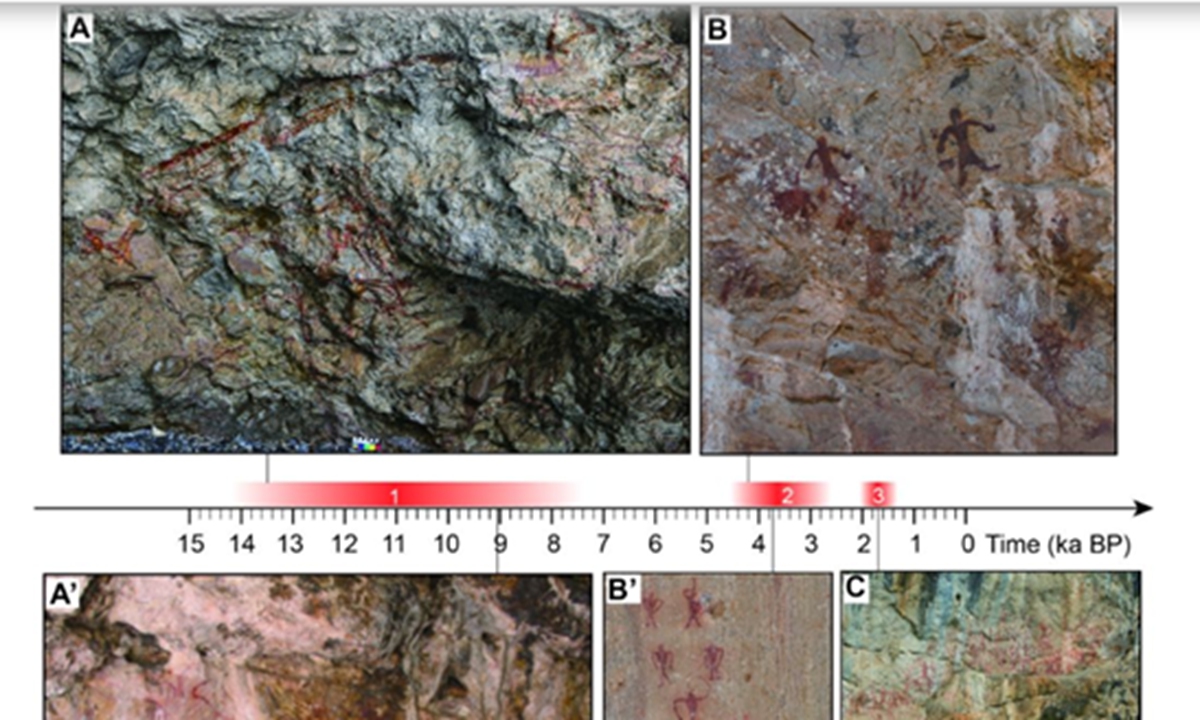
Timeline of the major painted rock art groups in Southwest China: A-A′: Jinsha River rock art; B-B′: Mangguan-Cangyuan rock art; C-C′: Zuojiang rock art Photos: Xinhua
Chinese researchers have obtained the first absolute dates for rock paintings at the Mangguan rock art site in Southwest China's Yunnan Province, pushing the known history of rock art created by prehistoric settled communities in the region back to about 4,220 years ago. The paintings also suggest cultural interactions more than 4,000 years ago between Southwest China and civilizations along the Yellow and Yangtze rivers, as well as possible exchanges with neighboring parts of Southeast Asia, including present-day Myanmar, Thailand and Vietnam, a member of the research team told the Global Times.
The Yunnan Provincial Institute of Cultural Relics and Archaeology, in collaboration with Nanjing Normal University and other institutions, have recently made a significant archaeological breakthrough. Through systematic surveys and uranium-thorium (U-Th) dating at the Mangguan site in Gengma county, the research team obtained the first absolute dates for the site's rock paintings, tracing rock art created by prehistoric settled communities back to around 4,220 years ago.
The findings were recently published in the international journal
Journal of Archaeological Science: Reports.
The Mangguan rock paintings represent one of the best-preserved prehistoric rock art sites in Yunnan. The research team presented high precision U Th dating of carbonate accretions that stratigraphically overlie the painted motifs at the Mangguan site, according to the paper published in the journal.
The dating results show that carbonate deposits overlying a human figure yielded a corrected age of 4,240 ± 19 years before present, confirming that ancient people living in the region had already produced mature figurative art at least 4,220 years ago, Wu Yun, first author of the paper and an associate researcher at the Yunnan Provincial Institute of Cultural Relics and Archaeology, was cited by the Xinhua News Agency report as saying.
Dating results from 11 samples taken from different motifs clustered between about 3,907 and 3,056 years ago. By comparison, the Cangyuan cliff paintings had previously been dated to roughly 3,800 to 2,700 years ago. The Mangguan paintings are therefore significantly older, filling an important chronological gap in the region's artistic record before the Cangyuan phase.
Shao Qingfeng, corresponding author of the paper and a professor at the School of Geography at Nanjing Normal University, told the Global Times that previous estimates dated the Mangguan rock paintings to a little over 3,000 years ago based mainly on imagery and comparisons with similar regional sites. Using microsamples of secondary carbonate deposits overlying the paintings, researchers have now obtained a precise minimum age of about 4,220 years before present without damaging the rock art.
The findings and the establishment of this chronological framework not only strengthen the archaeological foundation for studying rock art in Southwest China, but also provide a direct reference for rock art sites across Southeast Asia that have yet to undergo systematic dating, Shao said.
The findings may also challenge long-held perceptions of Southwest China around 4,200 years ago - roughly the era of the Xia Dynasty (c.2070 BC-C.1600 BC) - and help fill a key gap in understanding the pluralistic yet integrated development of Chinese civilization.
Shao said that while academic research has traditionally focused on the Yellow River and Yangtze River basins as cradles of early Chinese civilization, sites such as Mangguan and Cangyuan show that stable and culturally active communities also thrived in mountainous Southwest China. The newly established rock-art chronology brings an artistic dimension to the broader narrative of China's enduring cultural development.
Moreover, stylistic similarities suggest that Southwest China maintained exchanges with the Yellow River and Yangtze River regions and with early societies in Southeast Asia, providing material evidence of cross-regional interaction more than 4,000 years ago.
。

C | 戏曲里从来不缺爱情。牛郎织女鹊桥相会、张生莺莺隔墙和诗、白素贞断桥寻夫、梁祝化蝶双飞,这些耳熟能详的爱情故事,在戏曲里经久不衰。

D | 《中华有好戏》七夕特别节目抓住这个打动人心的主题,精选《牛郎织女》《红娘》《花为媒》《白蛇传》《梁祝》等经典曲目,让名角化身"爱情推荐官",边唱边讲,把老故事里的东方浪漫讲给观众听。黄梅戏"五朵金花"之一 吴琼:我们有才子佳人的,但是我们又有老百姓的,美好生活都有。最脍炙人口的,树上的鸟儿成双对,然后还像我们《女驸马》也有,清风明月做见证,分开一对玉麒麟,这都是表达爱情的。中国戏剧梅花奖获得者 罗慧琴:兰花指这样,一对新人,然后结合在一起,有一个小害羞的动作,这样,偷看自己心爱的人就是这样,用这个水袖挡上,一点一点的眼神往这边看、看、看到。观众:原来戏曲一点儿都不沉闷,舞台也特别好看,算是七夕一份很特别的收获。好故事需要好角儿唱出来。

E | 本场演出,十九朵"梅花"同时绽放。茅威涛、沈铁梅两位梅花大奖得主,刘秀荣、韩再芬两位二度梅获得者,加上吴琼、罗慧琴等实力派名家,老中青少四代梨园人同台献艺。87版电视剧《红楼梦》贾宝玉扮演者欧阳奋强跨界加盟,担任越剧《红楼梦》推荐官。87版电视剧《红楼梦》贾宝玉扮演者 欧阳奋强:我本人也是戏曲演员出身,在我塑造贾宝玉这个角色的时候,戏曲的滋养给了我很大的帮助。我跟是有感情的,为什么呢?是因为咱们《红楼梦》很多的戏,就在正定荣国府拍的。
F | 中国戏剧梅花大奖获得者 茅威涛:我希望以我自己在越剧观众、越剧戏迷当中的这些影响力,能够让更多的热爱越剧的以及热爱其他一些剧种的观众朋友们,能够通过我的推荐,感兴趣、了解了、知道了,能够来关注咱们这个栏目。中国戏剧梅花大奖获得者 沈铁梅:中国的戏曲我们有我们自己的美学体系,是一个文化大省,而且我们是自上到下,都特别关注中华传统文化,特别是中国戏曲。所以我觉得这是一个文化自信的一个表现和一个态度,我们为中华有好戏、为点赞。中华有好戏,唱响中国节。以一场戏曲与爱情的唯美相逢,《中华有好戏》邀您共赴七夕浪漫之约。今晚20:00点,锁定卫视、冀时新闻客户端,与您不见不散。
Current article:http://abx.foujiongwenruapoumeizhan.buzz/list_wfpt9fm/y5cl06.xls
Published on:13:42:26